



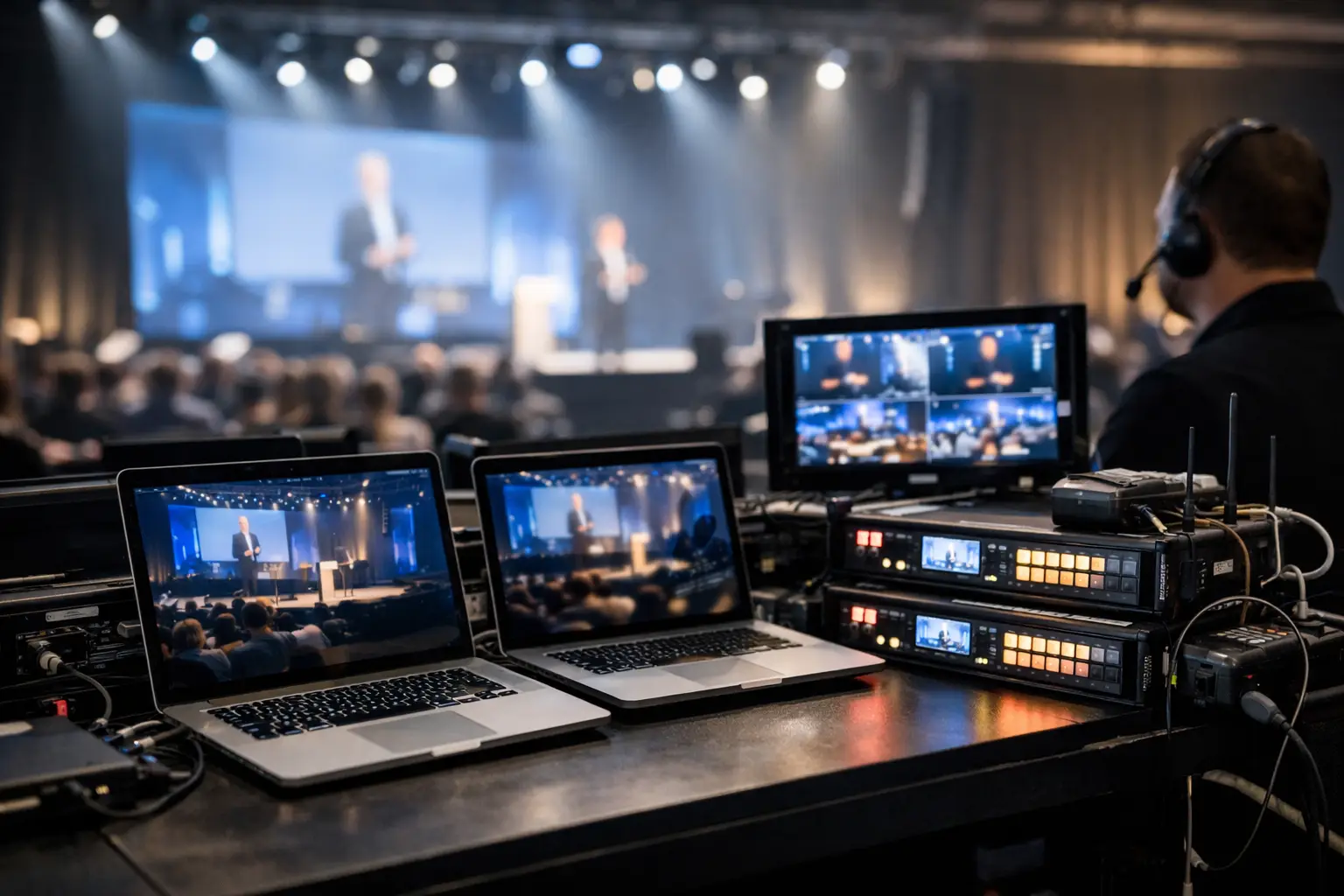
How We Build Redundant AV Systems for Corporate Keynotes
Corporate keynotes often encounter failures in subtle ways. A laptop handshake drops. A fiber run gets kicked loose backstage. The primary playback machine freezes on the CEO’s opening slide. When clients ask how we build redundant systems specifically for Corporate Keynotes, that’s the real conversation – focusing on practical solutions to eliminate single points of failure before the room fills.
For corporate shows, redundancy isn’t just one feature or device; it’s a comprehensive system design approach. Each major signal path is evaluated for potential consequences, recovery time, and operator control. Some elements in Corporate Keynotes require instant failover. Others can manage a brief reset without the audience noticing. The challenge lies in determining which components need which level of redundancy while still maintaining a seamless flow during the event.
How we build redundant systems for corporate keynotes
We start by identifying the critical paths for the show. In most Corporate Keynotes, these involve presentation playback, screen management, switching, audio reinforcement, show communications, recording, livestream distribution, and power. If any of those systems fail at a crucial moment, the audience will definitely notice.
This doesn’t mean we duplicate every piece of equipment on site. While full duplication sounds appealing in budget discussions, it’s often not the most efficient engineering choice for Corporate Keynotes. In some instances, a hot backup is a wiser option. In others, it might be a pre-routed alternative source on the switcher or maintaining the same show file on two separate playback systems with a dedicated operator ready to step in. Effective redundancy targets essential aspects, while inefficient redundancy can create clutter and complicate setups.
For larger corporate general sessions, we design independent primary and backup paths specifically for media playback and screen processing. If the event incorporates widescreen canvas outputs, layered graphics, multiple confidence feeds, and LED walls, the processing chain becomes just as critical as the content source. Systems built around image processing platforms like Barco become indispensable, providing professional-grade routing, memory management, and operational discipline essential for Corporate Keynotes. Barco event master platform is a widely accepted standard for this level of work, especially in live environments where a failed transition is unacceptable.
Redundancy starts at the source
To achieve successful Corporate Keynotes, it’s imperative to set up the right systems and protocols.
Most failures in Corporate Keynotes begin upstream. A switcher can only cut to what it has, emphasizing the necessity for source redundancy.
If a presenter is using keynote content from a show laptop, we prefer a matched backup machine loaded with identical media, fonts, output settings, adapters, and any last-minute revisions for Corporate Keynotes. If the show contains video roll-ins, walk-on music, lower thirds, and speaker timers, these elements may exist on separate playback systems entirely. By keeping presentation playback distinct from show media, we reduce risk and enhance reliability for Corporate Keynotes.
For executive presentations, we also pay attention to human redundancy. A backup laptop is useful only if the switching plan is clear and the stage team knows who can call the move. We label primary and backup paths consistently, build them into the run of show, and rehearse the handoff. Fast recovery is usually less about gear than operator readiness.
The planning for Corporate Keynotes involves not just equipment but also thorough preparation of all team members.
In high-end keynote environments, display systems are rarely straightforward. A center screen, side screens, confidence monitors, comfort monitors, press feeds, overflow rooms, LED walls, and livestream outputs often demand different looks simultaneously. This inherent complexity introduces hidden failure points that can disrupt Corporate Keynotes.
This is where screen management is engineered into its own layer. We utilize processing that permits prebuilding alternative looks, keeping backup inputs active, and ensuring clean output mappings in case of source failure. In scenarios where timing is critical, the processor configuration is treated like show control, not merely routing. The goal is not just having a backup source; it’s about making it immediately usable across all important destinations during Corporate Keynotes.
If you’re assessing event production partners for Corporate Keynotes, inquire about their methods for handling processor-level failover, destination mapping, and operator workflows. These specifics reveal more than generic assurances regarding backup gear. On complicated shows, video processing is one of the initial areas where we refine the design. This is why many clients turn to us for expertise with Barco E2 and E3 systems and the operators skilled in crafting a successful live corporate environment.
If you are evaluating event production partners, ask how they handle processor-level failover, destination mapping, and operator workflow. Those details tell you more than a generic promise of backup gear. On complex shows, video processing is one of the first places we tighten the design. That is also why many clients come to us specifically for Barco E2 and E3 systems and the operators who know how to build around them in a live corporate environment.
Audio redundancy differs from video redundancy in Corporate Keynotes
Video failures are visible, but audio failures can silence the room during Corporate Keynotes.
For keynote events, we approach audio redundancy in layers: microphone strategy, console architecture, playback routing, DSP, and distribution. A single wireless handheld for a CEO may suffice for smaller shows, but higher-stakes events commonly require alternate options, spare capsules, spare frequencies, and a clear backstage plan for swift swaps. Lavaliers also necessitate the same level of care, particularly during wardrobe changes or quick executive transitions in Corporate Keynotes.
Console redundancy varies with show scale. Some events warrant a fully mirrored audio control path, while others are more effectively served by a stable primary console with protected stage inputs, backup playback, and disciplined scene management. This variance depends on the repercussions of failure and the level of change occurring during the show. A panel discussion with multiple live microphones presents different risks than a tightly scripted product launch.
The AVIXA guidelines for live event audio planning are particularly beneficial, reinforcing what experienced crews already understand: reliability arises from thoughtful system design, gain structure, RF coordination, and operational processes—not merely from the quantity of equipment featured in Corporate Keynotes.
Livestream and recording failover in Corporate Keynotes
Hybrid keynote production introduces an additional layer of complexity. The room can endure a brief confidence monitor issue, but your remote audience will not excuse a dead stream during Corporate Keynotes.
For livestreams, we differentiate production from distribution. The live program feed might originate from the same switcher managing in-room content, or it could be produced separately based on the show’s requirements. Regardless, we plan for backup encoders, redundant network paths where applicable, local recording, and secure records of critical sources. If a CDN handoff fails, we want the event captured and recoverable for Corporate Keynotes. If the stream encoder fails, we require a secondary path that can be activated without necessitating a full show rebuild.
This is a key reason why full-service corporate event production is crucial. Livestream redundancy is effective only if video, audio, networking, and stage management are aligned under a single technical strategy. Fragmented disciplines result in slower failover, jeopardizing the success of Corporate Keynotes.
Power, signal transport, and the unforeseen failures in Corporate Keynotes
Some of the most detrimental failures are unrelated to the headline equipment. A keynote can be compromised by unreliable power, a defective converter, a damaged patch cable, or a hurried backstage repatch just minutes before doors open during Corporate Keynotes.
Hence, we build from the infrastructure up. Critical systems receive conditioned power and thoughtful circuit planning. Signal transport is selected based on distance, environment, and serviceability. Fiber is excellent in many venues, provided that patching and protection are managed properly. SDI offers benefits in certain workflows due to its predictability and quick troubleshooting capabilities. NDI and networked video can be efficient, but they demand disciplined network management and should not be treated as magic in Corporate Keynotes.
This is where extensive experience in conference centers, hotel ballrooms, and temporary event setups becomes invaluable. The optimal design for a Silicon Valley hotel general session may not apply to a downtown San Francisco theater with outdated infrastructure. Redundancy strategies must be tailored to specific venue conditions for Corporate Keynotes.
Balancing protection and complexity in Corporate Keynotes
Increased backup does not automatically equate to better outcomes. Each added layer elevates setup time, testing requirements, and operator workload for Corporate Keynotes. If the show team is unclear about the failover path, redundancy can lead to confusion precisely when it’s meant to assist.
This is why we continuously pose a straightforward question during planning: what occurs if this component fails, and how quickly do we need to recover for Corporate Keynotes? If the answer demands immediate recovery without visible interruption, we design for hot backup. If the answer involves controlled recovery in under 30 seconds, we may select an alternate approach that is easier to manage. The aim is resilience, not mere decoration.
For clients, this indicates that the right production partner should be capable of articulating the rationale behind every redundancy decision made for Corporate Keynotes. Not every show requires complete mirroring of equipment. However, every significant show necessitates a team that understands where failures are most likely to occur and has already devised a response plan.
Testing redundant systems before a Corporate Keynote goes live
The build is merely half the task. The other half is validating that it works for Corporate Keynotes.
We test failover deliberately. We switch to backup playback. We confirm alternate processor inputs. We check confidence monitors against primary and backup sources. We verify that recordings are properly writing. We assess stream paths, tally, intercom, and cueing for Corporate Keynotes. Then we repeat the process after rehearsals, since changes made for speakers can introduce new risks.
This phase also highlights how in-house capabilities can influence the outcome. When the same team manages video processing, playback, switching, livestreaming, and technical direction, troubleshooting is quicker and more effective. There’s reduced finger-pointing and fewer surprises between departments. If you require a partner capable of managing everything in-house for a Corporate Keynote, that operational model is far more significant than polished sales rhetoric.
A redundant keynote system should feel uneventful once the audience arrives. That is the objective. Engineering takes place early, testing occurs prior to doors opening, and recovery plans are already in the crew’s hands. If you are preparing for a high-stakes general session, product launch, or executive keynote, the optimal time to consider potential failures is well ahead of anyone stepping on stage during Corporate Keynotes.