

In-House Production vs Multiple Vendors for Events
A corporate keynote can have excellent cameras, a capable streaming crew, a strong lighting design, and a high-resolution LED wall – then still fail at the handoff between teams. That is the real question behind in house production vs multiple vendors. The decision is not simply about whether one company supplies more equipment. It is about who owns the signal path, who is accountable when a cue changes, and how quickly the show can recover when a component does not behave as planned.
For conferences, product launches, executive webcasts, and hybrid events, production structure directly affects risk. A multi-vendor model can work well under the right conditions. But as the room, run of show, and broadcast requirements become more complex, the coordination burden rises quickly.
In-House Production vs Multiple Vendors: The Operational Difference
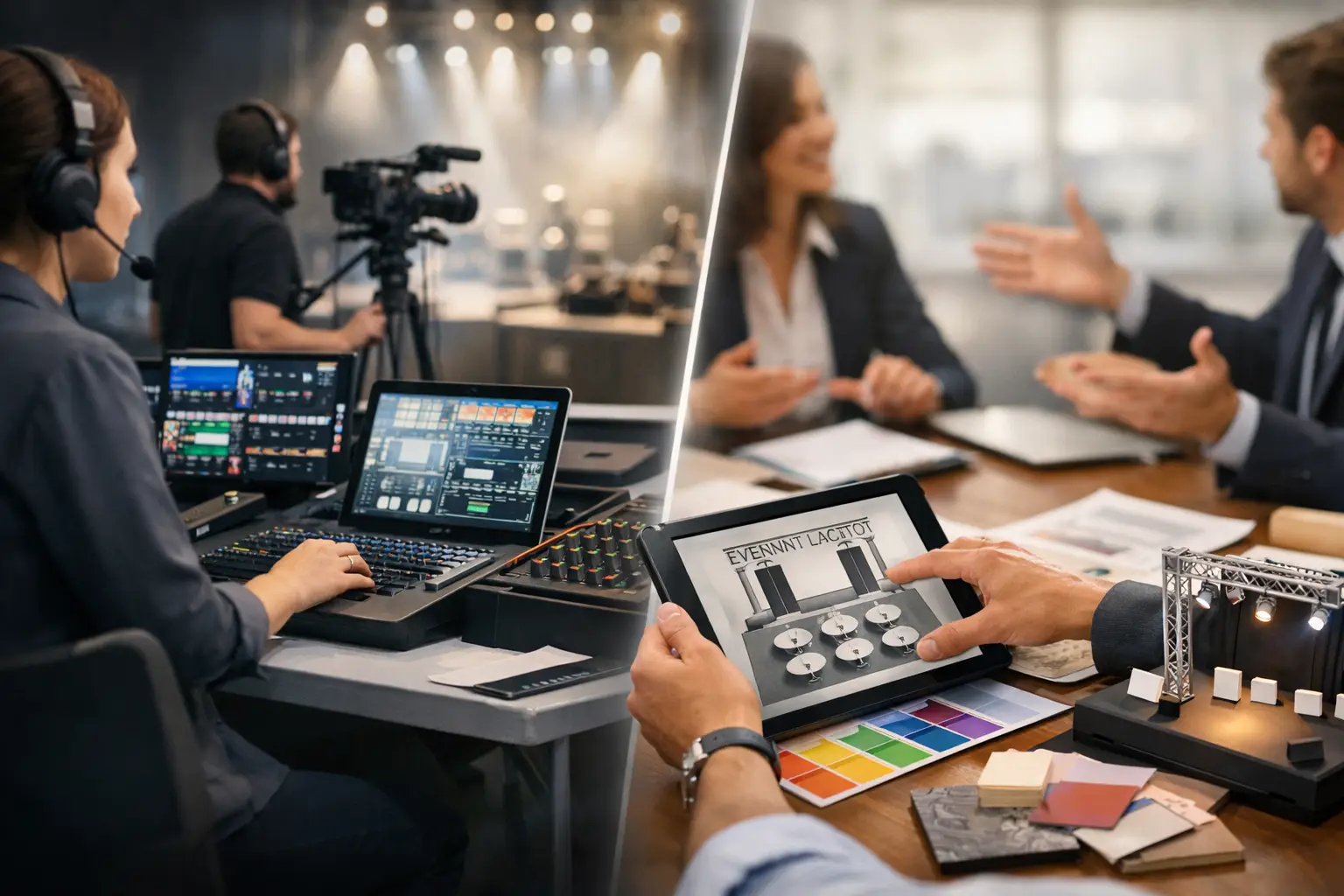
An in-house production model means one technical production partner plans and delivers the interconnected parts of the show. That may include LED walls or projection, cameras, audio, lighting, show control, playback, livestream encoding, crew, and on-site technical direction. The systems are specified together, tested together, and operated by people who understand the complete design.
With multiple vendors, those responsibilities are distributed. One provider may furnish staging and LED, another audio, a third cameras and streaming, and another labor or show calling. Each may be competent in its own area. The challenge is that corporate events do not operate in separate technical lanes. A presenter laptop feeds the switcher. The switcher feeds the confidence monitors, the LED processor, the records, the stream encoder, and often overflow rooms. One change can affect every destination.
The key difference is ownership of the interfaces. In a single-provider model, the production team owns the connections between disciplines. In a multi-vendor model, the client, venue, agency, or designated production manager often becomes the de facto integration layer unless that role has been assigned clearly and early.
Where Multiple Vendors Can Make Sense
Using multiple vendors is not automatically a mistake. It can be appropriate when a company has long-standing supplier agreements, a venue requires a specific provider, or a specialized element is already contracted separately. A national event agency, for example, may maintain a preferred scenic fabricator while bringing in a local technical production company for video, audio, lighting, and streaming.
The model can also work for a small, stable program. If there is one presentation screen, a basic microphone package, a single playback source, and no broadcast component, the handoffs are limited. Clear paperwork and a realistic load-in schedule may be enough to manage the risk.
The problem appears when the event grows beyond simple room AV but the production structure does not. A two-day conference with general sessions, remote presenters, IMAG camera coverage, breakouts, sponsor content, walk-in loops, confidence displays, and a live stream needs a coordinated technical design. It should not be managed as a collection of independent rentals and crews.
Signal Flow Is Where Fragmented Production Breaks Down
Signal flow is not a back-of-house detail. It is the operating map for a live event. Before doors open, the production team should know exactly where every source starts, how it is routed, what formats are required, where scaling occurs, and what happens if a primary path fails.
Consider a standard keynote setup: three cameras feed a production switcher; presentation content arrives at a Barco E2 or E3; program video feeds the main LED wall, downstage confidence monitors, a record deck, a stream encoder, and a press feed. Audio from the console needs clean mixes for the room, the broadcast program, recording, and remote contributors. Intercom must connect the technical director, camera operators, audio, stage manager, playback, and stream operator.
If these systems come from separate vendors, questions must be answered before load-in. Who supplies the converters? Who confirms frame rate and color space? Who provides reference and timecode if required? Who has control of EDID behavior at the presenter positions? Who troubleshoots a mismatch between the LED wall processor and the switcher output? When no team owns the full path, troubleshooting can turn into a discussion about where one vendor’s responsibility ends.
An integrated production partner reduces that ambiguity. The technical director can make decisions based on the whole show rather than only one equipment package. That is particularly valuable when schedule changes force last-minute revisions to screen layouts, remote guest workflows, or presentation formats.
Video Processing Requires a Single Point of Control
High-end corporate video environments often need more than a switcher and a projector. Multi-screen keynotes may require layered looks, PIPs, animated backgrounds, audience IMAG, custom screen mappings, and routing to multiple destinations. Barco E2/E3 processing is built for this type of canvas management, but it is only as effective as the preparation behind it.
The processor operator needs the correct display geometry, source inventory, backup routing plan, and show file before rehearsal. Camera shading, playback resolution, LED processing, and show control must align with the output design. Splitting these responsibilities across vendors can be successful, but only if one experienced technical lead has authority over the integrated system.
Redundancy Is a Design Decision, Not an Equipment Add-On
Corporate teams often ask for redundancy after a failure has already happened somewhere else. The more useful approach is to decide what must remain live and design protection around those functions.
For a hybrid keynote, that may mean dual internet paths, a primary and backup stream encoder, redundant playback, isolated program records, backup presentation playback, spare wireless microphones, duplicate critical signal converters, and alternate display routing. Not every element requires a duplicate. The appropriate level of redundancy depends on the cost of interruption, the program format, and the recovery time the event can tolerate.
A coordinated in-house team can prioritize redundancy across the system rather than overbuilding one area while leaving a weak point elsewhere. There is little value in a backup encoder if the only program feed reaches it through a single unprotected conversion chain. Likewise, a spare camera does not solve a problem if there is no preplanned route to bring it into the switcher.
Multiple vendors can provide redundancy, but the responsibility matrix must be precise. The production plan should identify each primary path, backup path, operator action, and decision-maker. If the stream drops during an executive presentation, the team should not need to decide in real time who is authorized to switch encoders or change network routes.
Rehearsal Time Reveals the True Cost
Multi-vendor quotes can appear less expensive because each scope is narrowly defined. The operational cost often shows up later in coordination calls, venue walkthroughs, duplicated testing, unclear labor boundaries, and extended rehearsals. That does not mean one vendor is always the lower-cost option. It means the comparison must include the management effort and exposure created by the handoffs.
For corporate events in San Francisco, San Jose, and Silicon Valley, schedules are often compressed by venue access, executive availability, and dense program agendas. A full production rehearsal may be the only window to confirm presenter confidence feeds, teleprompter workflow, remote guest returns, camera blocking, playback cues, and livestream moderation. A unified team arrives with the system already aligned around that rehearsal.
With multiple vendors, give the integration work the time it requires. Hold a technical kickoff, assign one production lead, exchange current signal-flow drawings, and lock the source and destination list before show site. Do not rely on a verbal assumption that each team will “make it work” at load-in.
What Corporate Teams Should Ask Before Choosing
The most useful questions are not only about inventory and price. Ask who owns technical direction during the show, who creates the master signal-flow diagram, and who approves format standards for video and playback. Confirm who manages client content, show files, networking, comms, records, and backup systems.
Also ask what happens during a fault. Who sees the problem first? Who has access to the routing, processors, consoles, and encoders? Can that person make a change immediately, or must another vendor be called to intervene? The answer should be operational, not theoretical.
A capable integrated team will explain the limits of its plan as well as its strengths. If a venue network is shared and unmanaged, that is a risk. If a remote executive has uncertain home connectivity, that needs a backup contribution plan. If presentation content arrives late in unfamiliar formats, the rehearsal and playback approach must account for it. Good production planning makes those conditions visible early enough to manage them.
Choose the Model That Matches the Show’s Risk
For a contained event with few technical dependencies, multiple vendors may be practical and cost-effective. For a conference or launch where video, live cameras, LED, executive presenters, and hybrid distribution must operate as one system, integrated production usually provides clearer accountability and faster recovery.
AV Land approaches corporate production from that operational perspective: build the system around the program, document the signal paths, test the failure points, and staff the room with operators who can act without delay. The goal is not to consolidate vendors for its own sake. It is to keep the technical structure from becoming the most fragile part of the event.
Before issuing scopes, map the moments your audience cannot miss: the opening walk-on, executive keynote, live demo, remote guest, product reveal, and closing call to action. Then choose a production model that gives one qualified team clear ownership of the systems those moments depend on.