



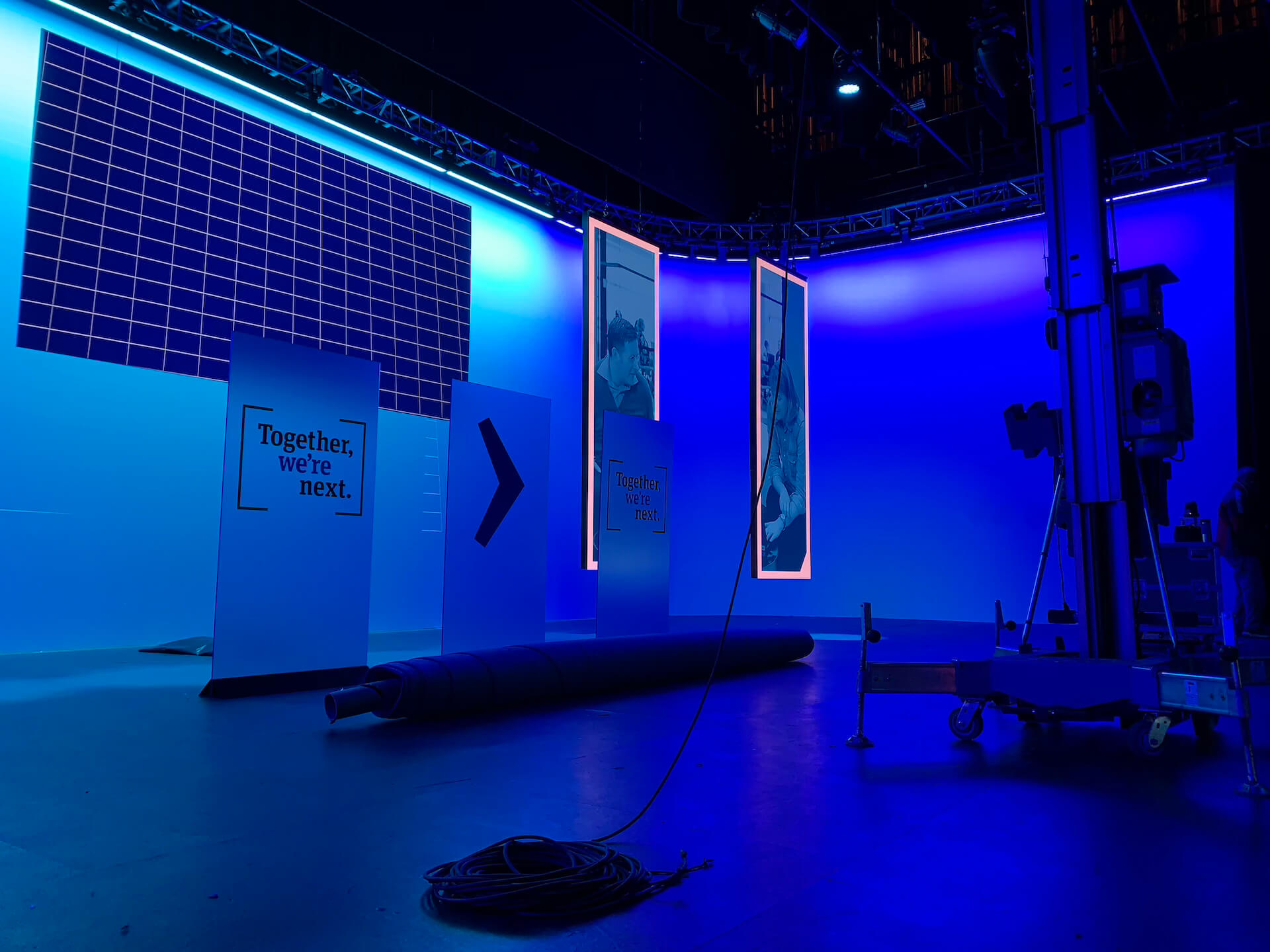
LED Wall Versus Projection: Which Fits?
If you have ever watched a keynote deck wash out the moment house lights came up, you already know that the LED wall versus projection decision is not cosmetic. It affects sightlines, camera exposure, room lighting, scenic design, load-in, and the confidence level of everyone calling cues.
For corporate events, the right display system is the one that holds up under real show conditions, not the one that looked fine in an empty ballroom during a sales demo. A product launch with IMAG, remote presenters, and sponsor content has different demands than a general session with a single presentation screen. That is why this choice needs to be made early, alongside staging, content format, and camera planning.
LED wall versus projection for live events
The simplest difference is this: projection relies on reflected light, while LED emits light directly. That one distinction changes almost everything.
Projection can still be the right call in the right room. A large front-projection or rear-projection screen may deliver plenty of image area at a lower entry cost, especially if ambient light is controlled and content is mostly slides or video playback. Systems from manufacturers like Christie and Panasonic are commonly used in corporate environments for reliable projection performance. But once you add camera packages, brighter stage washes, scenic looks, or a room with daylight issues, projection starts asking for compromises.
LED walls are much more forgiving in those conditions. They stay vivid under stage lighting, hold contrast better for cameras, and give designers more freedom with the room. For many corporate productions, that reliability is the real reason buyers move to LED, not just the visual impact. Systems from manufacturers like Absen and ROE Visual are widely used in corporate and live event environments due to their consistency and image quality.
Brightness is only part of the story
People often reduce this discussion to brightness, and yes, LED wins there. But brightness by itself is not the full picture.
A projected image can look excellent in a controlled environment. In fact, for some content types, especially widescreen scenic imagery viewed from a distance, projection can still feel natural and polished. The issue is that projection performance depends heavily on the room staying within a narrow operating window. Too much ambient light, the wrong throw distance, projector placement constraints, or a screen surface with poor gain, and image quality starts slipping fast.
LED gives you more operational margin. You can keep the room brighter for audience note-taking, maintain a cleaner look for on-stage speakers, and avoid building your entire lighting package around protecting the screen image. For conferences and executive presentations, that flexibility is often worth more than the raw pixel technology itself.
What looks better on camera
For hybrid events and livestreamed sessions, screen choice affects the broadcast feed as much as the in-room experience.
Projection can work on camera, but it is easier to run into exposure and contrast issues. If the stage is lit for faces and the screen is projected, your shader and engineer are balancing a narrower range. Dark slides may disappear. White backgrounds may flare. If presenters stand too close to the screen, things get worse quickly.
LED usually gives the video team more control. Content remains punchy, speakers can be lit properly, and the background reads better in wide shots. That matters for product announcements, town halls, and investor-facing events where the livestream is not secondary. It is part of the show.
There is a technical caveat. LED walls need the right processing, refresh behavior, and camera settings to perform cleanly on camera. A poorly configured LED wall can create moire or scan artifacts. This is where experienced engineering matters. The display choice is only as good as the team driving it.
Scenic flexibility and stage design
Projection generally wants a traditional screen surface and a defined projection path. That can limit where you place lighting, set pieces, cameras, and presenters. Rear projection solves some of that, but it introduces its own footprint behind the screen, which not every venue can support.
LED is physically more flexible. You can build a center wall, split walls, ribbon bands, side returns, floor-supported scenic elements, or widescreen formats that would be awkward with projection. For modern corporate staging, especially in the Bay Area where tech events often want a cleaner, more custom visual language, LED opens up more design options without forcing the room into an old screen-and-projector layout.
That said, LED is not automatically the better-looking choice. Pixel pitch, viewing distance, content design, and wall size all have to line up. A wall that is too coarse for close audience seating or for camera framing can look worse than a well-executed projection system. Good design starts with the room and the audience, not the gear list.
Cost: where projection still makes sense
This is usually the reason the conversation starts. Projection can be more budget-friendly, especially for simple general sessions where content is static, lighting is modest, and the room already supports the projection geometry.
If the objective is to put up a large image for slides and playback in a darkened room, projection often remains the efficient option. Not every meeting needs an LED wall. For breakout rooms, secondary spaces, or internal sessions with limited scenic demands, projection can be the practical choice.
But budget decisions should include labor, rigging, venue constraints, and show risk, not just display rental cost. A projection setup with difficult rigging positions, long-throw lens requirements, heavy drape treatment, and tight alignment windows can stop looking cheap once the full production picture is clear.
LED may carry a higher line item, but it can simplify other parts of the show. Faster content impact, fewer lighting compromises, cleaner camera results, and more flexible scenic use can offset that premium when the event has real visibility and no room for avoidable issues.
Venue limitations often decide the answer
Ballrooms, hotel ceilings, window lines, and union load-in rules have a way of turning theory into reality.
Projection depends on having the right throw distance, clean sightlines, and stable placement. In some rooms, that is easy. In others, chandeliers, low trim heights, architectural features, or audience scaling make it difficult. Rear projection is attractive until you realize the venue cannot spare the depth behind the screen.
LED walls are less dependent on room depth, but they bring their own planning needs. Weight loading, rigging points, power distribution, and access for build all matter. On larger corporate shows, these issues are manageable with proper advance work. On compressed schedules, they need to be handled by a team that has done it many times before.
This is why experienced production companies evaluate the room first and recommend the display second. There is no universal winner. There is only the right solution for the venue, audience, and show format.
Content matters more than most people think
A screen system should match the content package.
If your show is built around keynote graphics, motion backgrounds, walk-in loops, lower-thirds for IMAG, and branded scenic moments, LED gives content creators much more room to work. Blacks feel cleaner, color has more authority, and the stage reads like a designed environment instead of a projection setup with scenery around it.
If your content is mostly presentation slides with conservative templates and occasional video playback, projection may be perfectly adequate. The issue is when teams expect projection to deliver LED-style impact without adjusting content or room conditions. That is where disappointment shows up.
Resolution planning matters too. An LED wall should be built to a practical pixel count that matches the processor workflow and content canvas. Projection should be specified around the actual image size and viewing requirements, not just the biggest lumen number available. Display systems fail most often at the planning stage, not on show day.
When we recommend LED and when we recommend projection
For executive keynotes, product launches, brand-forward general sessions, and hybrid events with a serious broadcast component, LED is usually the stronger choice. It creates fewer compromises across lighting, staging, and camera coverage. It also gives presenters a more polished environment, which clients notice immediately.
For budget-sensitive meetings, breakout rooms, or sessions in venues that naturally support projection, projectors still have a place. They are not outdated. They are just less tolerant of bad room conditions and more dependent on surrounding design choices.
At AV Land, we usually frame this as a production systems question, not a screen question. The display has to support switching, playback, graphics, camera blocking, and the pace of the show. Once you look at it that way, the right answer becomes much easier to defend internally.
The real question is risk tolerance
Most buyers asking about LED wall versus projection are really asking something else: where can we afford compromise?
If the event is high stakes, heavily branded, or camera-driven, projection can introduce more variables than many teams realize. If the event is straightforward, the room is controlled, and the budget is better spent elsewhere, projection may be the smarter move.
A good production partner should be able to walk through those trade-offs without pushing one format by default. The best screen is the one that supports the entire show architecture and keeps your team out of trouble when the room fills up, the lights come on, and the show goes live.
Choose the display that gives you margin, not just image size. That is usually the difference between a screen that works and a screen that carries the event.