


Onsite AV Team vs Freelancers for Corporate Events
A keynote is six minutes from doors. The confidence monitor has a different output than the main LED wall, the remote presenter needs a return feed, and the show caller is waiting on a last-minute deck revision. This is where the onsite AV team vs freelancers decision stops being a staffing question and becomes an execution question.
For a straightforward meeting with one screen, one microphone, and a fixed agenda, a skilled freelance technician can be the right fit. For a conference, product launch, executive webcast, or hybrid event with multiple technical systems running at once, the cost of fragmented responsibility can appear quickly. The issue is not whether freelancers are capable. Many are excellent operators. The issue is whether the crew is planned, connected, and accountable as one production system.
Onsite AV Team vs Freelancers: The Operational Difference
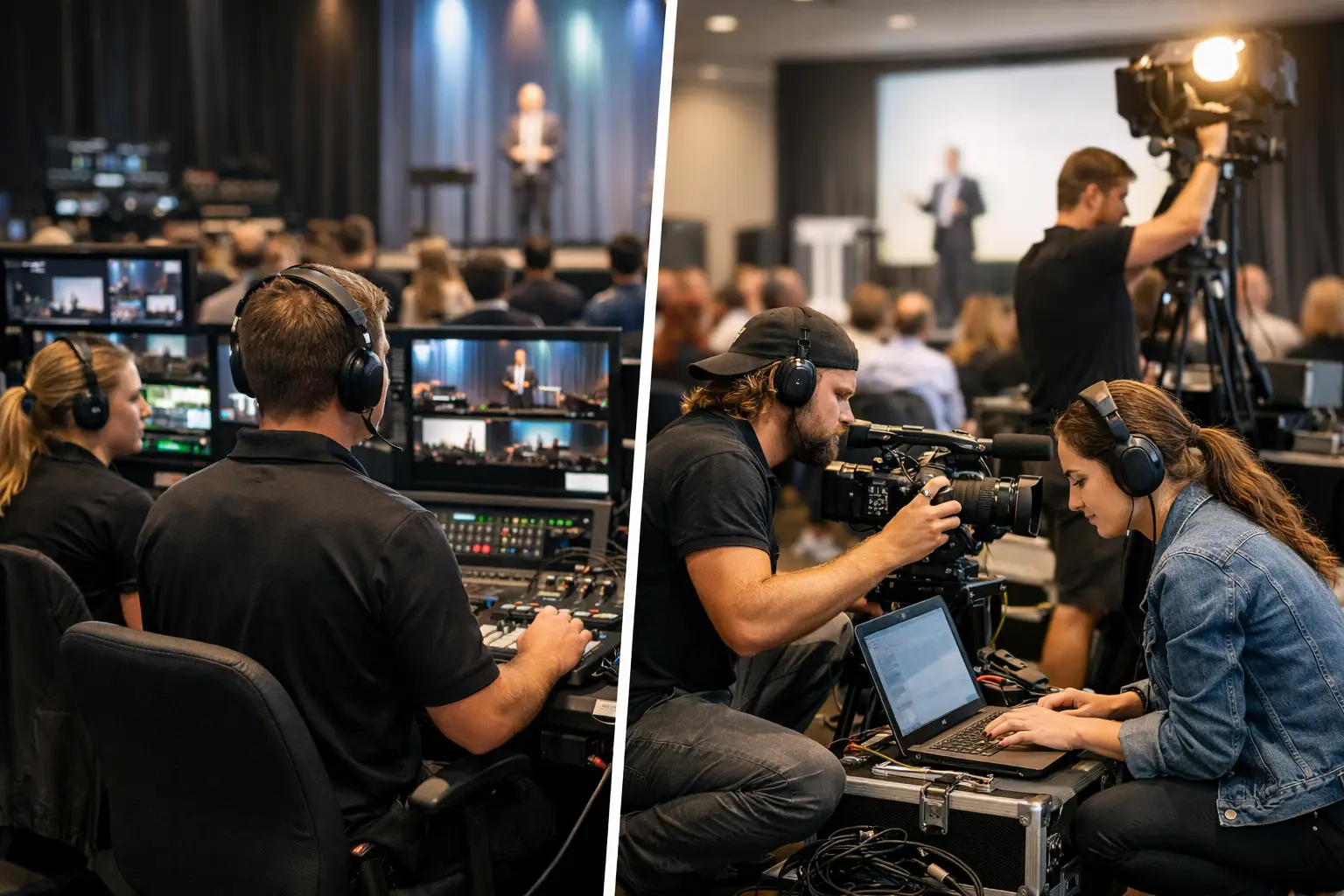
An onsite AV team is typically built around a single production plan. Technical direction, audio, video, cameras, graphics, lighting, playback, and streaming are scoped together before load-in. The team arrives with defined roles, shared show documents, tested equipment packages, and a clear chain of command when a cue changes or a fault occurs.
A freelance model can mean several different things. It may be one technician hired to support venue equipment. It may be a group of independent specialists brought together by an agency or planner. It can also be a production company using freelancers as part of an established crew. Those scenarios are not equal.
The risk rises when independent operators are booked separately, receive different information, or are expected to solve integration issues onsite. A camera operator may be excellent, but camera coverage still depends on intercom, shading, routing, recording, stage blocking, and the video switcher’s show plan. A streaming operator can run a platform well, but the stream still depends on clean program feeds, embedded audio, confidence monitoring, network testing, and backup paths.
For corporate events, the strongest question is not, “Do we have enough people?” It is, “Who owns the system when every department is live at the same time?”
Signal Flow Is Where Staffing Decisions Become Visible
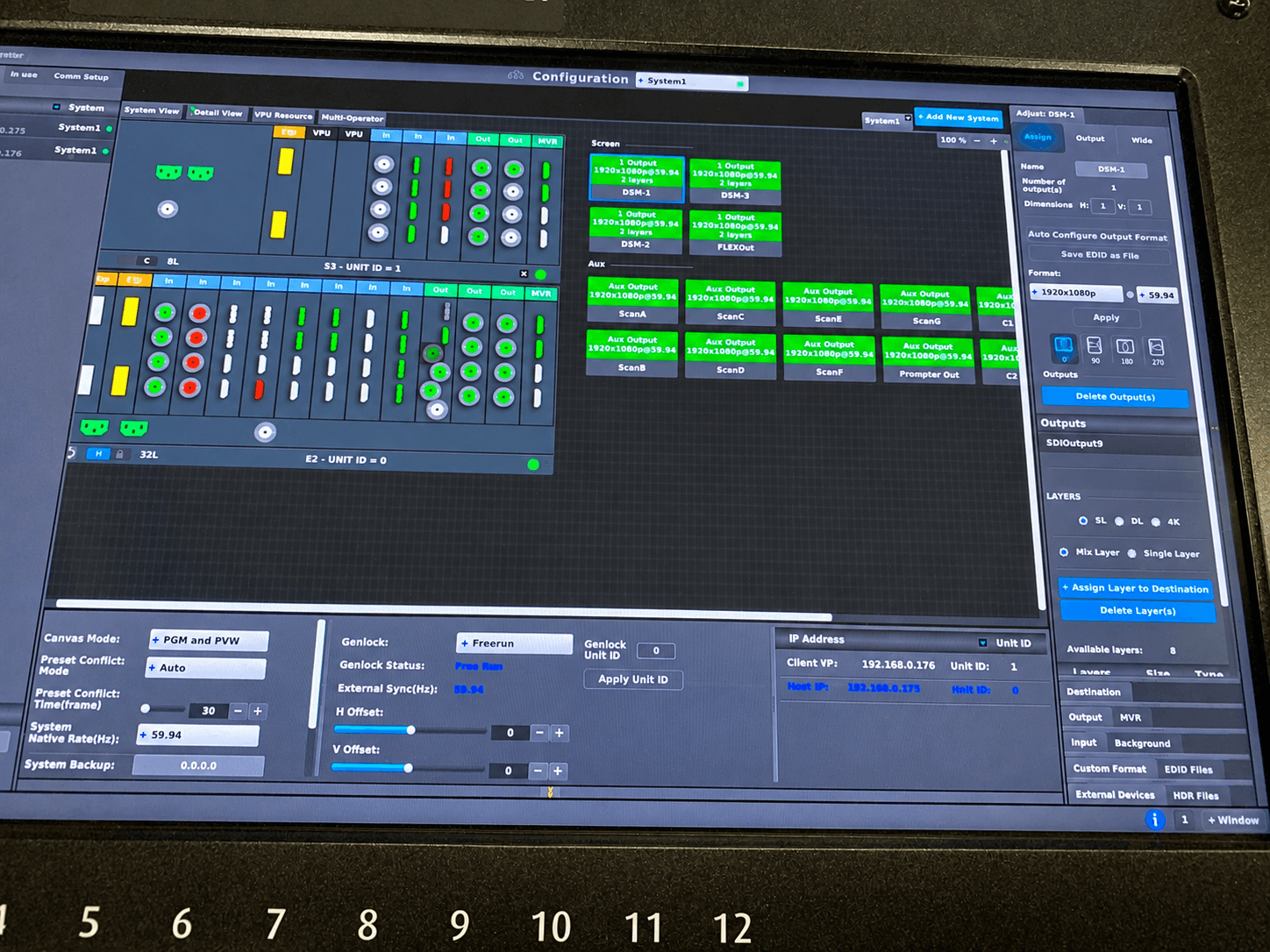
Corporate productions often rely on signal paths that are invisible to attendees but essential to the show. A presenter’s laptop may feed a switcher, a Barco E2 or E3 processor, the room displays, confidence monitors, a recorder, an overflow room, and a livestream encoder. Audio may need separate mixes for the room, remote viewers, press feeds, records, and video playback.
When one technical partner designs the system, those paths are documented and checked as a whole. Inputs and outputs are labeled. Resolutions and frame rates are confirmed. EDID behavior, HDCP exposure, conversion points, and cable runs are addressed before presenters are standing by. The crew knows which feed is program, which is clean, which is presentation-only, and which one supports the teleprompter or remote guest return.
With separately hired freelancers, signal flow can still work well, but it requires unusually strong preproduction. Someone must create the drawings, assign responsibility for every handoff, and confirm that each operator understands the complete path rather than only their own position. Without that discipline, troubleshooting can turn into a search for the person whose scope includes the problem.
Complex video systems need a technical owner
LED walls, multi-screen canvas layouts, image magnification, and branded keynote environments add another layer. A processor operator cannot make good decisions in isolation from camera framing, graphics formats, playback timing, and stage design. The video lead needs authority to protect the screen configuration, call for correct source delivery, and make controlled changes during rehearsals.
This is especially relevant for Silicon Valley product launches and executive keynotes, where content teams may deliver late revisions and expect immediate results. An experienced onsite production team can evaluate whether a request is safe to execute before show time, identify the impact on downstream outputs, and provide a practical alternative if it introduces risk.
Redundancy Is More Than Extra Equipment
Event planners often hear that a system has redundancy, then assume the job is protected. Redundancy only matters if the backup path has been designed, tested, and assigned to an operator who knows when to use it.
A meaningful plan may include backup playback, spare presentation adapters, alternate network connections, a secondary recording path, replacement microphones, redundant power distribution, or a prepared fallback signal for a display system. For a hybrid event, it may also include a backup encoder configuration, local program recording, and a defined procedure if the event platform or venue internet becomes unstable.
An onsite AV team is better positioned to build these layers into the original scope because it controls the equipment package and the labor plan. The team can rehearse the transition from primary to backup systems. It can determine whether a backup is truly independent or merely another device dependent on the same power, network, or signal source.
Freelancers can bring backup gear and strong contingency instincts, but they cannot always solve for redundancy across systems they do not own or manage. If the audio engineer, camera crew, LED wall vendor, stream operator, and venue each have separate scopes, a failure may expose gaps between those scopes.
When Freelancers Are a Smart Choice
Freelancers are not automatically the wrong choice. They can be an efficient option when the technical scope is narrow, the system is already standardized, and a knowledgeable production manager is coordinating the work.
A single experienced audio technician may be appropriate for an internal meeting with a basic PA and limited microphones. A dedicated camera operator can strengthen coverage for a simple interview recording. A specialist may also be the best addition to an existing production team when a particular skill, such as a specific lighting console or a specialized camera platform, is required.
The model works best when one party still owns technical direction. That owner should approve the equipment list, distribute a show flow, coordinate load-in timing, verify communication channels, and make final decisions during rehearsal. Freelancers become most effective when they are integrated into a defined production structure rather than asked to create that structure onsite.
What an Onsite AV Team Changes During Show Week
The visible benefit of a coordinated team is calm under pressure. The more significant benefit happens earlier: advance calls, site surveys, equipment prep, graphics specifications, network requirements, run-of-show review, presenter management, and rehearsal planning.
During load-in, a production team can stage equipment according to the build sequence and test each department before the room becomes crowded. Audio confirms RF coordination and playback. Video verifies display destinations, multiview layouts, and source switching. Camera and streaming teams confirm framing, return video, latency, and recording. Technical direction connects those checks to the actual show cues.
During the event, the show caller has a crew that shares the same terminology and escalation path. If an executive changes the order of speakers, the decision reaches playback, graphics, cameras, audio, and streaming through one command structure. If a remote guest loses a connection, the team can maintain room pacing while the appropriate operator resolves the issue.
That coordination matters most when there is no time to explain the stakes. A live corporate program has one clock. Attendees, executives, remote viewers, and content teams all experience the result at once.
How to Choose the Right Staffing Model
Start with the technical consequence of failure. If a minor problem can be handled with a brief pause and little audience impact, a lean freelance approach may be reasonable. If failure affects a CEO keynote, investor-facing presentation, product announcement, global webcast, or multi-room conference, use a team that can plan and operate the full system.
Also consider the number of handoffs. Each additional vendor, venue department, remote platform, or content source increases the need for technical direction. A production partner should be able to state who owns signal routing, show calling, network coordination, recording, content intake, display processing, and contingency decisions before anyone arrives onsite.
Budget still matters, but comparing day rates alone can hide the real cost. A lower initial labor figure may exclude preproduction, integration, backup equipment, rehearsals, and someone accountable for the whole show. A properly staffed team may cost more on paper while reducing the operational risk that causes expensive last-minute changes.
For high-stakes Bay Area corporate productions, AV Land builds crews around the actual signal flow and show requirements, not a generic labor count. The goal is not to add people unnecessarily. It is to place the right technical authority at every point where a live program can fail or change.
The right crew should give your presenters room to focus on the message, your planning team a clear escalation path, and your audience a program that stays under control when the schedule does not.