


Hybrid Event Production Services That Hold Up
A hybrid event usually looks fine in the planning deck. Then rehearsal starts, remote presenters join late, slides come in with the wrong aspect ratio, the CEO wants confidence monitors moved, and the webcast audience expects broadcast-level delivery without any patience for mistakes. That is where hybrid event production services stop being a line item and start being the part that protects the event.
For corporate conferences, keynotes, product launches, and internal broadcasts, hybrid production is not just live AV plus a streaming link. It is one show with two audiences, two viewing environments, and very different failure points. The in-room audience will tolerate a brief camera reposition. The online audience will leave in seconds if audio drops, graphics lag, or the stream freezes.
That gap matters when you are choosing a production partner.
What hybrid event production services should actually cover
At a professional level, hybrid event production services are about show control. The room, the stream, the content playback, the screen management, the presenter experience, and the recording workflow all have to work as one system.
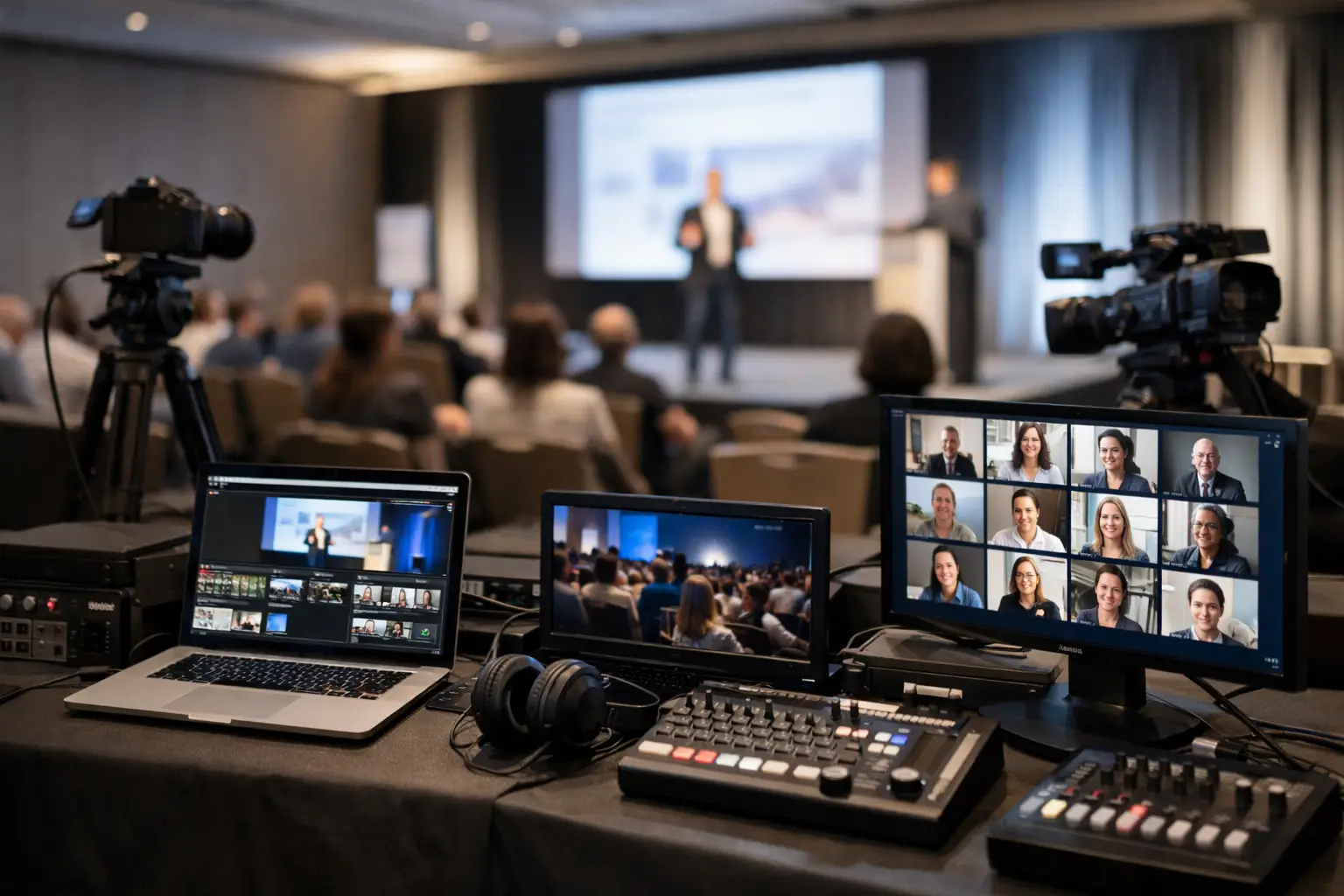
For a corporate event, that usually starts with camera coverage,live switching systems, audio mixing for both house and broadcast, presentation management, and an encoded stream delivered to the chosen platform. But the real value is in how those pieces are engineered together.
A ballroom IMAG feed is not the same as a webcast program. A room may need brighter screens, larger type, and a different camera framing than the online audience. Panel discussions often need separate audio treatment for in-person reinforcement and streamed clarity. Walk-on music that feels right in the room can easily overpower a webcast mix if nobody is actively mixing for both outputs.
This is why experienced teams build separate paths where needed. One show, yes, but not one-size-fits-all signal flow.
Why hybrid events fail even when the gear list looks good
The gear matters. Operator judgment matters more.
A proposal can include quality switchers, good cameras, a capable streaming encoder, LED walls, and professional audio, yet the event still struggles because the production plan did not account for real conditions. Presenter laptops show up untested. Playback machines are not mirrored. The internet path is assumed instead of verified. Remote guest returns are treated like an afterthought. Nobody has mapped what happens if the main machine fails during a keynote.
In hybrid production, failure usually comes from small gaps between departments. Video assumes audio is handling remote returns. Audio assumes the streaming team is managing latency. Graphics assumes every display is 16:9 and scaled correctly. The show caller assumes presenters understand timing marks. Those handoff points are where expensive events get shaky.
The best production teams close those gaps before show day. They define signal paths, backup paths, operator roles, comms, cueing, playback ownership, slide formatting, and stream monitoring. The event feels calm because the technical plan is specific.
The case for in-house technical control
For complex corporate shows, fragmented production is risky. When camera ops, audio, screens, livestreaming, and show direction are split across too many vendors, troubleshooting slows down right when decisions need to happen fast.
A tighter model is better. If one production company can handle video processing, camera systems, switching, streaming, LED display support, and on-site technical direction, the show benefits from a single engineering approach. That means fewer translation errors between teams and faster response when something changes mid-show.
This is especially true when a show relies on advanced video workflows. Large-format keynote sessions, multi-source general sessions, and content-heavy conferences often need more than a simple switcher setup. They need proper screen management, layered composition, confidence feeds, speaker support, and clean routing across multiple destinations. Systems like Barco E2 and E3 are valuable here because they let teams manage complex visual outputs with precision, but only if the operators know how to build and run the show around them.
Hybrid event production services for corporate shows
Corporate events have a different standard than general live events. The audience may include investors, customers, partners, analysts, or internal leadership. The content may be confidential. The speakers may be executives with no extra rehearsal time. The show often has to look polished in the room, on the stream, and in the archive recording.
That changes what good service looks like.
A corporate production partner should be able to support multi-camera coverage for keynotes and panels, clean playback of brand-critical content, broadcast-ready livestreaming, confidence monitor systems, remote speaker integration, and stage management that keeps sessions on time. They should also understand the political side of the room. When a VP asks for a last-minute content swap or a speaker wants to bypass the plan, the crew has to solve the problem without turning the room into a visible scramble.
In the Bay Area, this is common. Tech events move quickly. Product messaging changes late. Demo feeds can be unpredictable. Executive expectations are high. Hybrid event production services need to reflect that environment, not a generic event template.
What to ask before you hire a hybrid production team
The fastest way to evaluate a production company is to ask how they handle risk.
Ask who owns show flow on site. Ask whether they build separate audio mixes for house and stream when needed. Ask how they manage presenter playback, graphics integrity, and aspect ratio issues across room screens and online delivery. Ask what redundancy exists for switching, playback, recording, and internet connectivity. Ask how remote presenters are tested and cued before they go live.
You should also ask what happens during a failure. Not in theory, but in practice. If the primary playback machine dies, who cuts to backup and how quickly? If a remote panelist has echo, who identifies whether the issue is mix-minus, platform latency, or the panelist’s local setup? If the LED wall processor needs an adjustment during rehearsal, who owns that change and verifies the downstream impact?
Experienced teams answer these questions directly. They have done it before, and their answers sound operational, not promotional.
Production design should match the audience experience
Not every hybrid event needs the same build.
A leadership town hall may prioritize message clarity, reliable streaming, and clean recording over a heavy scenic package. A customer-facing keynote may put more emphasis on camera composition, screen impact, walk-in content, and branded motion playback. A breakout-heavy conference may need repeatable room packages with centralized stream monitoring and standardized presenter workflows.
The trade-off is usually between complexity and control. Bigger visual ambition can raise the production value, but it also raises the demand for rehearsal time, content discipline, and engineering depth. That does not mean simpler is better. It means the production approach has to fit the show.
Good hybrid event production services do not oversell a format. They build around the audience, the venue, the content load, and the consequences of failure.
Why livestream quality is only part of the job
Many buyers start with the stream because it is visible and easy to measure. Bitrate, platform, resolution, and recording specs all matter. But hybrid production is rarely won or lost by the encoder alone.
It is won by presenter confidence, accurate cues, readable graphics, stable returns, proper camera blocking, and audio that translates well to laptops, phones, in-room PA, and archive playback. It is also won by disciplined rehearsal. The more complex the event, the more the team needs real run time with actual content, real presenters, and the final signal chain.
That is why high-end corporate production crews spend so much time on pre-show verification. The audience only sees the finished result. The reliability comes from what happened before doors.
What a strong partner brings to the table
A serious hybrid partner brings more than equipment. They bring engineering logic, operator depth, and calm execution under pressure.
That includes technical direction that keeps all departments aligned, video systems designed for the actual room and screen package, camera plans that support both IMAG and webcast needs, and streaming workflows with monitoring and backup strategy built in. It also includes realistic guidance. Sometimes a venue internet circuit is not good enough. Sometimes the content needs to be reformatted before show day. Sometimes the agenda needs a few more seconds between cues if you want the show to feel tight instead of rushed.
That kind of honesty saves events.
For teams producing corporate shows in San Francisco, San Jose, and across Silicon Valley, the bar is not whether a vendor can show up with gear. The bar is whether they can run a high-stakes room and a live online audience at the same time without making the complexity visible.
That is what hybrid event production services should deliver. If the plan is right, the room stays focused, the stream stays stable, and your team gets to think about the message instead of the mechanics.
If you are evaluating partners, look past the package list and listen for how they talk about execution. That is usually where the real answer is.