



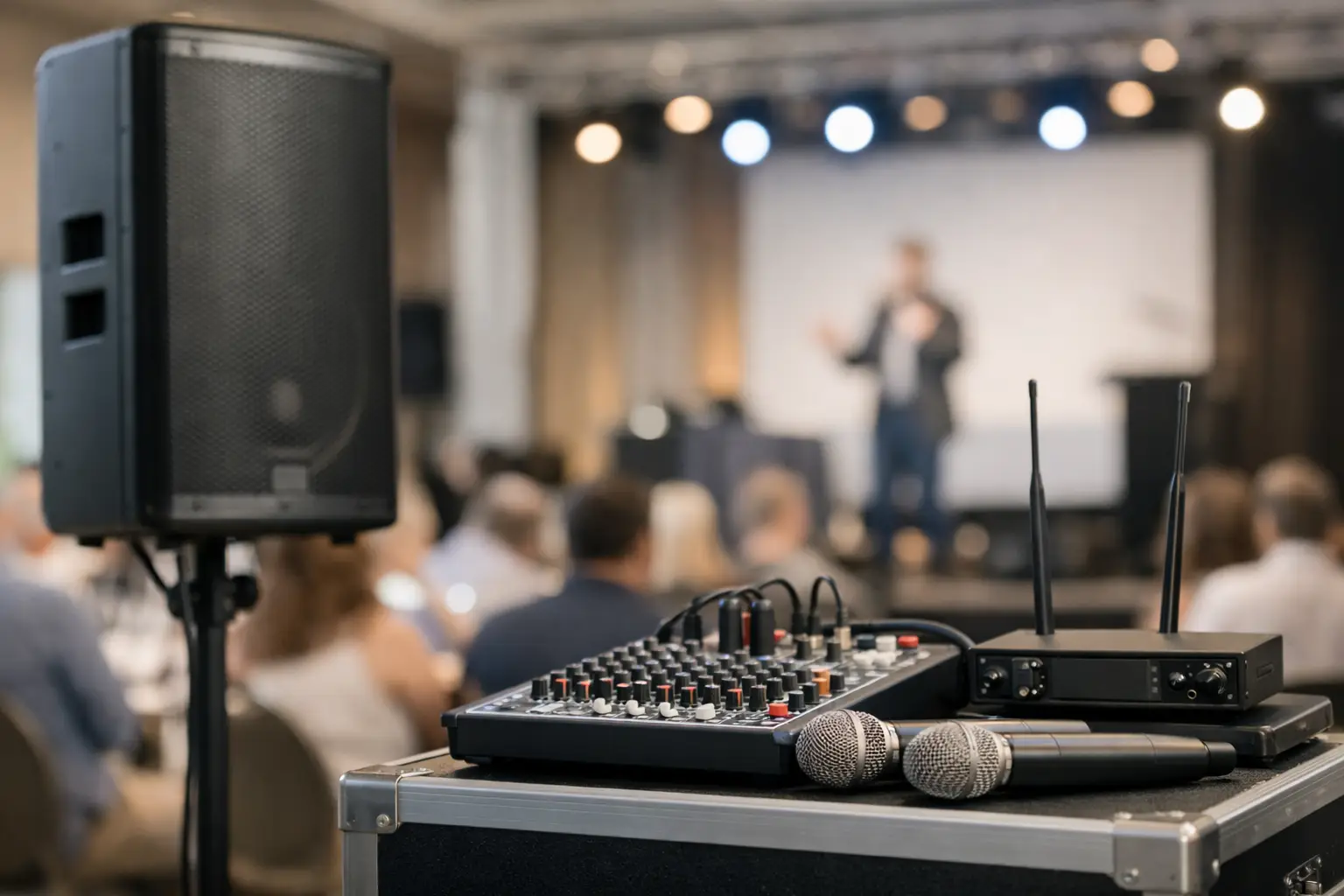
PA System Rental for Events That Works
When a keynote starts two minutes late because the lav pack is fighting interference, nobody in the room cares that the LED wall looks great. They remember the audio problem. That is why pa system rental for events is not a side order on a production quote. In corporate environments, it is the system that determines whether every cue, speaker transition, panel answer, and remote presenter actually lands.
For conferences, product launches, executive town halls, and hybrid productions, the right PA is less about volume and more about control. You need even coverage across the room, clear speech intelligibility, clean gain before feedback, and a signal path that holds up when the show gets busy. That usually means treating the PA as part of the production infrastructure, not just a pair of speakers on sticks.
What corporate PA system rental for events really includes
A professional PA package for a corporate event should start with the room, the agenda, and the show flow. A ballroom keynote with walk-in music, CEO remarks, panel discussion, and playback cues has a very different audio requirement than a breakout room with one handheld mic and a confidence monitor feed.
In practical terms, the rental should account for loudspeakers, front fills or delays when needed, wireless microphones, podium mics, a digital console, playback devices, distribution, cabling, stands, RF coordination, and monitoring for presenters or stage management. If the event is being recorded or livestreamed, the PA also needs to coexist with a broadcast mix. That matters because a room mix and a stream mix are rarely the same thing.
This is where many generic rentals fall short. They can provide equipment, but not always a system design that reflects the actual event format. Corporate shows need audio that can handle openers, walk-up stings, video playback, multiple presenters, audience Q and A, interpreters, remote guests, and last-minute program changes without forcing a reset in the middle of the day.
The biggest mistake: sizing the system by guesswork
One of the fastest ways to create problems is choosing a PA based on rough attendance numbers alone. A 300-person general session in a low-ceiling hotel ballroom behaves differently from a 300-person event in a wide expo hall with reflective surfaces. Ceiling height, room width, stage placement, audience density, drape, and even scenic elements affect coverage and intelligibility.
A properly specified system starts with the space. Speech-driven events need consistent vocal clarity at the back of the room without overpowering the front rows. If the room is deep, delay speakers may be required. If it is wide, front fills can help cover the seats nearest the stage. If the stage is heavy with LED walls or scenic pieces, speaker placement becomes even more important.
Volume is easy. Even coverage is harder. And for executive presentations, even coverage is what clients are paying for.
Speech clarity matters more than raw output
Corporate audiences are not there to feel bass in their chest. They need to hear the presenter clearly, especially in rooms with dense slide content, technical demos, or investor-facing messaging. That changes the system choice.
For most corporate work, the priority is intelligibility first, musical reinforcement second. That does not mean playback should sound thin. It means the system should reproduce walk-in tracks and video content cleanly while keeping spoken word articulate and stable. A well-tuned line array or point-source system can do both, but the right choice depends on room size and deployment constraints.
Microphone selection also matters. Lavaliers give presenters freedom, but they are less forgiving than a handheld if wardrobe, mic placement, or head turns become an issue. Headset mics provide better consistency, but not every executive wants that look. Podium mics work for scripted remarks, but they are limiting for dynamic presenters. There is no universal answer. The right call depends on the speaker, the stage blocking, and how much movement the show requires.
Why operator support changes the value of the rental
A PA package without experienced audio support is often where risk enters the room. Corporate events move fast. Speakers arrive late, walk-up music changes, video playback levels vary, and panelists share microphones in ways nobody planned. A capable A1 or lead audio tech manages those variables in real time.
That includes ringing out the room, managing wireless frequencies, setting gain structure correctly, coordinating playback feeds, and keeping the show clean as cues stack up. On larger productions, it may also mean separate roles for FOH mixing, monitor support, RF management, and broadcast audio.
For event planners and internal marketing teams, this is not a minor detail. Operator support is what turns rented gear into a functioning show system. Without it, even premium equipment can underperform.
Redundancy is not optional on high-stakes shows
If the event includes executive leadership, investors, press, or a livestream audience, redundancy should be built into the audio plan. That does not always mean doubling every component, but it does mean identifying failure points and covering them properly.
Wireless microphones need frequency coordination and spare channels. Playback machines should have backup content paths. Critical outputs to overflow rooms, records, or streaming encoders should be distributed cleanly and monitored. Consoles and DSP paths should be configured with enough flexibility to recover quickly if a source fails.
This is especially important in San Francisco and Silicon Valley venues where RF environments can be crowded and show expectations are high. The more complex the event, the less room there is for improvising after doors open.
PA rental and livestreaming need to be planned together
A common issue on hybrid events is assuming the room mix can simply feed the stream. It usually cannot. The audience in the room hears natural acoustic energy from the stage. Remote viewers hear only what is sent into the encoder. If that feed is taken directly from a PA-focused mix, remote audio often feels thin, uneven, or disconnected.
For events with streaming, recording, or IMAG-heavy production, the audio workflow should be designed as a full signal ecosystem. Presenter mics, playback, remote callers, confidence returns, video roll-ins, and audience Q and A all need to be routed intentionally. In some cases, that means a dedicated broadcast mix. In others, it means a console setup with well-managed matrices and auxes.
The key point is simple: if the event is hybrid, the PA is only one part of the audio job. Professional PA systems for corporate events rely on proven audio brands to ensure clarity and reliability. At AV Land, we use industry-standard solutions such as d&b audiotechnik, Meyer Sound, QSC, Yamaha Professional Audio, and Shure microphones to deliver consistent, high-quality sound for corporate events and live productions.
What to ask before booking a PA system rental for events
The right questions are operational. Ask how the system is being sized for the room. Ask what microphone package is recommended based on the agenda. Ask how playback, walk-in music, remote presenters, and Q and A will be handled. Ask whether the rental includes an experienced operator, RF coordination, tuning, and on-site troubleshooting.
You should also ask how the provider handles changes. Corporate events rarely stay frozen between quote approval and show day. Speaker counts change. Video segments are added. A panel becomes a fireside chat. A breakout turns into a press room. A good production partner builds a system that can flex without forcing a last-minute technical compromise.
This is also where in-house inventory matters. When a provider handles the audio package, video workflow, livestreaming, and show operation together, there is usually less friction between departments and fewer handoff failures. That is one reason companies like AV Land are often brought in for full-service corporate event production rather than isolated equipment drops.
When a simple PA package is enough, and when it is not
Not every event needs a large-format system. A breakout room, training session, or internal meeting can often be handled with a compact PA, a few wireless channels, and a small digital console. If the room is controlled and the agenda is straightforward, keeping the system lean is often the smart move.
But once the show includes executive speakers, scenic staging, multiple content sources, room overflow, recording, or live streaming, the job changes. At that point, the PA has to integrate with a wider production system. That is where planning, engineering, and operating experience matter far more than the rental line items themselves.
The best audio setup is usually the one the audience never notices. They just hear every word, every cue happens on time, and the program moves without friction. That is the standard corporate events should be built around, especially when the stakes are public, the schedules are tight, and there is no second take.
If you are evaluating pa system rental for events, focus less on speaker counts and more on whether the system has been designed for your room, your agenda, and your failure points. Good audio is not just heard. It holds the whole show together.