



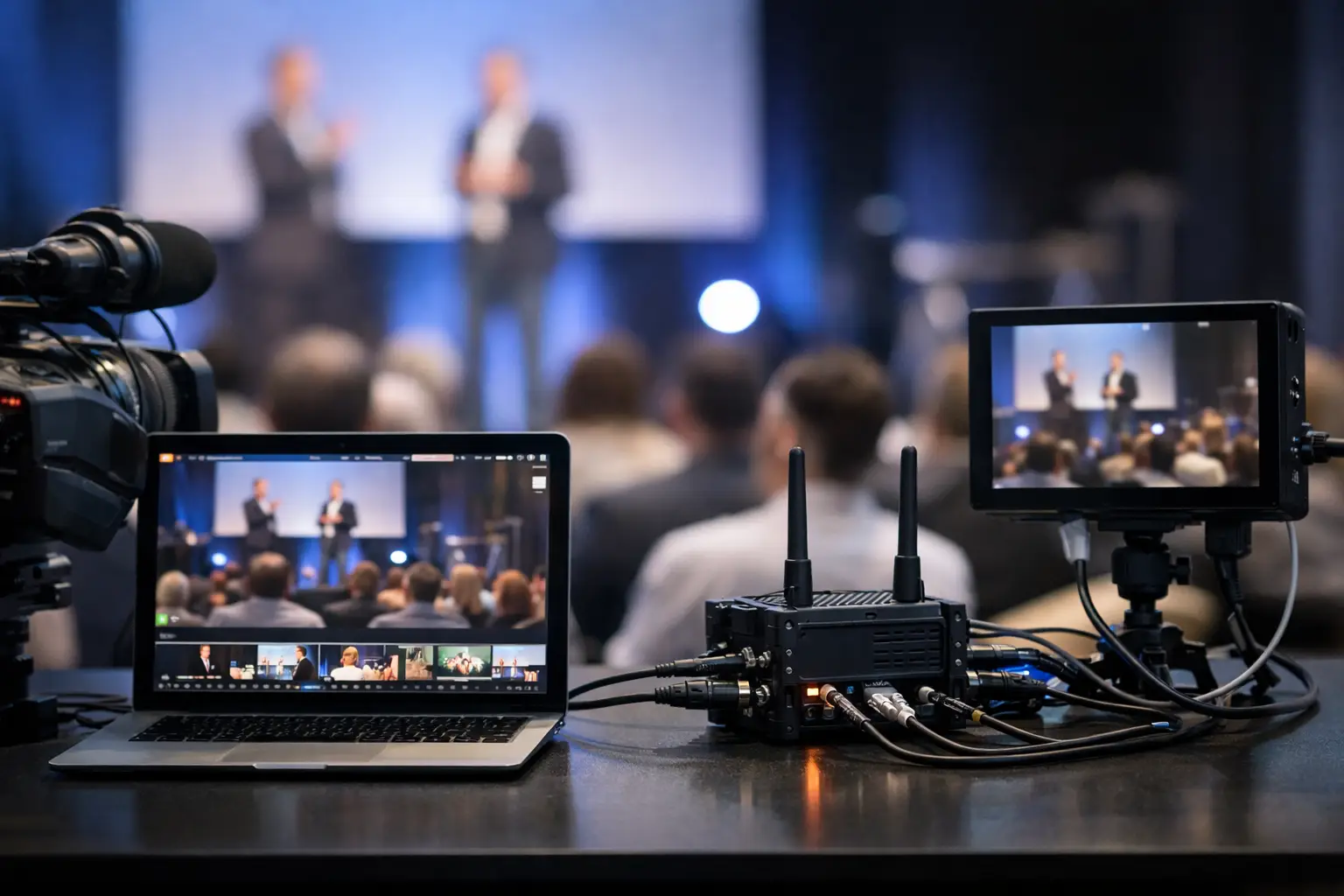
RTMP Versus SRT Streaming for Corporate Events
A corporate keynote can have a flawless camera cut, clean audio mix, and polished graphics, then still fail online because the stream transport was chosen as an afterthought. The practical decision in RTMP versus SRT streaming is not about picking a winner. It is about defining where the signal is going, what network conditions exist at the venue, how much delay the program can tolerate, and what happens when the primary path drops.
For Bay Area conferences, executive webcasts, product launches, and hybrid events, RTMP and SRT often work best together. RTMP remains common for platform ingest. SRT is frequently the better choice for getting a high-value program feed from the venue to a remote production team, cloud encoder, or distribution point over an unpredictable internet connection.
RTMP Versus SRT Streaming: The Operational Difference
RTMP, or Real-Time Messaging Protocol, has been a standard part of live streaming workflows for years. It is widely supported by hardware encoders, software encoders, social platforms, and many enterprise streaming services. In a typical event setup, the program output from a switcher or video processor feeds an encoder, and that encoder pushes an RTMP stream to a platform endpoint.
SRT, or Secure Reliable Transport, was designed for a different problem: moving live video reliably across less-than-perfect networks. It can compensate for packet loss, jitter, and changing network conditions through configurable latency and retransmission. It also supports AES encryption, which matters when a confidential executive presentation or unreleased product announcement is moving across public internet paths.
The distinction is simple in practice. RTMP is often the final handoff into a streaming platform. SRT is often the transport path used to protect the contribution feed before it reaches that platform.
That does not make RTMP obsolete. A platform may accept only RTMP ingest, and a local wired connection with sufficient dedicated bandwidth can make RTMP entirely appropriate. The mistake is assuming platform compatibility and transmission resilience are the same requirement.
Where RTMP Fits Best
RTMP is a practical choice when the encoder is streaming directly to a destination that explicitly supports it, such as a webcast platform, social channel, or corporate video portal. It is easy to configure, available across most encoder ecosystems, and familiar to on-site operators.
For a straightforward executive webcast, an RTMP workflow may be as direct as program video from the switcher to a primary hardware encoder, then to the client’s approved platform. With a properly tested, dedicated wired circuit and realistic upload headroom, it can be dependable.
RTMP also works well as the final delivery protocol when a remote production workflow uses SRT upstream. For example, cameras, playback, presentation graphics, confidence monitors, and audience IMAG can remain on-site. The switched program mix can travel by SRT to a remote control room or cloud production environment. From there, the production team can encode and publish RTMP to the destination platform.
The trade-off is that RTMP rides on TCP. TCP prioritizes complete delivery, but when packets are lost, its recovery behavior can add delay and affect the smoothness of a live feed under stressed network conditions. That is less of a concern on a clean, dedicated circuit than on venue Wi-Fi, shared hotel internet, or a connection competing with attendee traffic.
Where SRT Changes the Risk Profile
SRT uses UDP and adds mechanisms specifically intended for reliable video contribution. Instead of treating every lost packet like a general web transaction, it gives operators control over a latency buffer that can absorb network variation and request retransmission when needed.
This does not mean SRT can create bandwidth that does not exist. If a venue connection is saturated, severely restricted, or intermittently disconnected, no protocol can guarantee a perfect program. What SRT does provide is a more controlled response to ordinary packet loss and jitter, which are common on real-world internet paths.
For corporate event production, SRT is particularly useful in several situations:
- A conference program must travel from a San Francisco hotel ballroom to a remote producer or broadcast operations center.
- A keynote includes high-value content that needs encrypted transport between locations.
- A client wants a remote executive, presenter, or camera feed integrated into a live switch.
- The primary stream must cross a managed network where a fixed port, encryption setting, and predictable receiver workflow can be planned in advance.
- A redundant feed is needed from the event site to a separate destination or backup encoder.
SRT’s flexibility also creates more setup responsibility. Caller, listener, and rendezvous modes must be matched correctly. Port rules, firewall policies, encoder versions, latency settings, codec compatibility, and receiver capacity all need verification before show day. A protocol is only reliable when the complete signal path is tested.
Latency Is a Design Decision
SRT is often described as low latency, but the right question is: low latency relative to what level of network instability? A 120-millisecond latency setting may be acceptable on a clean local network, yet too aggressive for a long-haul public internet route with periodic packet loss. A larger buffer can make the feed more stable, but it adds delay.
This matters most when talent needs to interact with a remote audience, when a remote presenter is taking cues from the stage, or when an operator is shading cameras from another location. Video delay, audio delay, return-feed delay, and platform delay must be evaluated together. Reducing one part of the chain does not solve an interaction problem if the viewing platform adds 20 seconds downstream.
For one-way executive webcasts, a few extra seconds in the contribution path may be a reasonable trade for a more stable transmission. For live two-way Q&A, the production plan may need a dedicated return path, modified cueing, and a platform selected for real-time interaction rather than standard webcast delivery.
Signal Flow Matters More Than the Protocol Label
The strongest streaming workflows begin with a signal-flow diagram, not an encoder menu. Before selecting RTMP or SRT, define the program source, primary encoder, backup encoder, network handoff, streaming destination, monitoring points, and failover procedure.
A high-end corporate setup might begin with camera feeds, presentation playback, and remote contributors entering a production switcher. A technical director manages the program composition, while separate outputs provide stage displays, confidence, recording, and stream feeds. If the event uses an LED wall or complex canvas, a Barco E2 or E3 workflow may handle screen management independently of the stream encoder output.
The streaming path should receive a clean, intentional program feed. It should not be an afterthought taken from an auxiliary output without confirming frame rate, color range, embedded audio, graphics, and downstream format requirements. The online audience needs its own quality-control view, because a show that looks correct on the room display may not translate properly to a 16:9 webcast player.
For full-service corporate event production, AV Land plans camera, video processing, audio, lighting, recording, and streaming as one coordinated system. That approach prevents common failures such as mismatched audio embedding, incorrect presentation scaling, or a streaming encoder receiving a feed that was never intended for the online audience.
Build Redundancy Around the Actual Failure Points
Redundancy is not simply placing two encoders on a table. Effective redundancy separates failure domains.
A primary and backup RTMP encoder using the same switch, same ISP handoff, same power circuit, and same destination account may protect against a single encoder failure. It does not protect against network loss or a destination-platform problem. Likewise, an SRT feed to a backup receiver is useful only if the receiver and its outgoing delivery path are independently capable of taking over.
A realistic corporate streaming plan may include a primary wired internet circuit, a secondary independent connection, separate encoder outputs, local ISO recordings, and active monitoring of both the outgoing feed and the viewer experience. In some cases, bonded cellular is appropriate as a backup path. In others, the venue’s network architecture or security policy requires a pre-installed dedicated circuit and a network engineer’s approval.
The right level of redundancy depends on the cost of interruption. An internal all-hands meeting and a public product announcement do not carry the same exposure. That is why network testing should cover sustained upload capacity, packet loss, jitter, DNS behavior, firewall rules, and realistic bitrate settings, not just a quick speed test during load-in.
Choosing RTMP, SRT, or Both
Choose RTMP when the primary requirement is direct compatibility with a known streaming destination and the outgoing network is controlled, tested, and sufficiently provisioned. It remains an efficient, widely supported delivery method for many corporate webcasts.
Choose SRT when the critical challenge is getting a contribution feed safely and consistently from one location to another across variable internet conditions. It is especially valuable for remote production, multi-site events, encrypted feeds, and workflows where a dependable transport link is more important than direct platform ingest.
Choose both when the event needs professional-grade transport upstream and broad platform compatibility downstream. In many complex productions, SRT carries the feed to the point of distribution, while RTMP handles the final publish to the viewer platform.
Before a webcast goes live, confirm the destination requirements, identify every network handoff, run a sustained end-to-end test, and document the fallback path. The protocol choice should support the show plan, not become the show plan.