



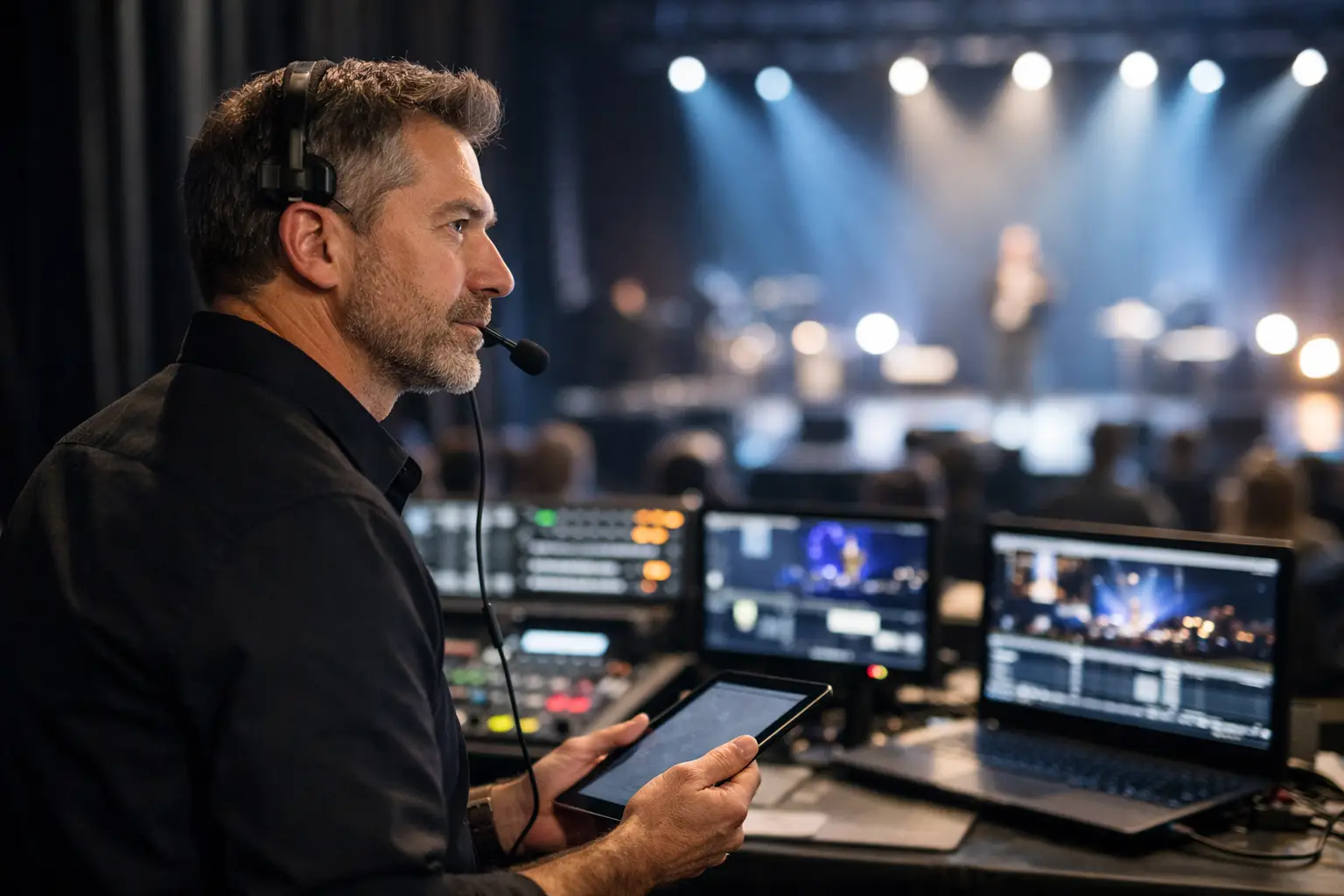
How to Choose an Event Technical Director
Knowing how to choose an event technical director means looking beyond a job title, equipment list, or impressive résumé.
You are selecting the person responsible for turning the production plan into a controlled live system. When the program changes, a presenter arrives late, a confidence monitor loses signal, or a remote speaker cannot hear the room, the technical director helps the crew respond without allowing one issue to disrupt the entire event.
For corporate conferences, executive meetings, product launches, webcasts, and hybrid programs, the right technical director reduces uncertainty before doors open and gives every department a clear operating structure once the show is live.
How to choose an event technical director at a glance
Before hiring an event technical director, evaluate the following:
- Role definition: Clarify whether the person will switch video, oversee all technical departments, call cues, or perform a combination of roles.
- Comparable experience: Look for productions with similar audience size, screen design, executive visibility, camera coverage, streaming, and cue complexity.
- Signal-flow knowledge: They should understand how audio, video, presentation, screen, recording, and streaming systems connect.
- Pre-production discipline: Ask what documents, technical plans, and questions they prepare before load-in.
- Rehearsal leadership: They should use rehearsal to test transitions, presenters, cues, remote contributors, and recovery procedures.
- Communication: Look for concise, calm, specific language rather than vague promises.
- Redundancy planning: They should identify the failures that matter most and explain practical recovery paths.
- Hybrid-event understanding: They need to recognize that the room audience and online audience require different feeds and monitoring.
- Crew fit: Confirm that their responsibilities are realistic for the staffing model.
- Decision-making: Ask how they evaluate late changes, stop unsafe requests, and protect upcoming cues.
- References and work history: Verify what they personally controlled on previous shows.
- Availability: Confirm participation in planning calls, site surveys, rehearsals, show days, and post-event review.
First, define what “technical director” means for your event
The title technical director can describe different responsibilities depending on the production company, venue, broadcast model, and event scale.
On one show, the technical director may:
- Switch cameras
- Call camera shots
- Control the production switcher
- Coordinate graphics and playback
On another show, the technical director may:
- Oversee the complete technical system
- Coordinate audio, video, lighting, streaming, and stage departments
- Approve signal flow and system architecture
- Lead technical rehearsals
- Manage recovery decisions
A separate show caller may coordinate the timing of cues across every department, while an E2 operator, video director, A1, lighting director, and streaming engineer operate their individual systems.
Before interviewing anyone, document the responsibilities you expect them to own.
Questions to answer before hiring
- Will the technical director operate a video switcher?
- Will they call cameras?
- Will they call cues across all departments?
- Will there be a separate show caller?
- Will they design the technical signal flow?
- Will they supervise department leads?
- Will they lead rehearsal?
- Will they communicate directly with the client?
- Will they manage livestream and remote-contributor workflows?
- Who has authority to hold or stop the show?
Do not compare candidates until the expected role is clear. Two people may both be experienced technical directors while specializing in substantially different areas.
Start with the actual complexity of the show
Not every event requires the same level of technical direction.
A small meeting with one screen, one presentation computer, and several microphones may need an experienced AV lead who can coordinate basic setup and cueing.
A multi-day conference with LED walls, image magnification, remote presenters, playback, lower thirds, audience Q&A, overflow rooms, recording, and livestreaming requires a dedicated technical lead with broader system and show-management experience.
Evaluate the show using factors such as:
- Number of rooms
- Audience size
- Number of presenters and panels
- Executive or public visibility
- Number and type of screens
- Custom LED pixel canvases
- Camera count
- Presentation and playback sources
- Graphics and lower thirds
- Remote contributors
- Livestream destinations
- Recording requirements
- Number of technical departments
- Cue density
- Rehearsal time
- Consequences of interruption
Every additional source, destination, operator, presenter, and live transition increases the number of handoffs that must be coordinated.
Identify what can fail publicly
Ask which technical failures would be immediately visible to the audience or client.
Examples include:
- The main LED wall losing signal
- The presentation computer freezing
- A confidence monitor showing the wrong source
- A keynote microphone failing
- A remote guest losing return audio
- The livestream disconnecting
- A product demonstration failing
- Playback audio not reaching the room or stream
- An incorrect lower third appearing on screen
The higher the consequence of failure, the more important it becomes to hire someone with comparable live-show experience and the authority to shape the technical plan early.
Evaluate live-show experience—not only equipment knowledge
A candidate may know a specific switcher, camera, processor, or streaming platform and still be unprepared to direct a high-pressure corporate program.
Equipment familiarity matters. Live decision-making matters more.
Look for experience with events similar to yours:
- Executive keynotes
- Investor or analyst presentations
- Corporate town halls
- Technology conferences
- Product announcements
- Multi-camera livestreams
- Hybrid programs
- Panel discussions
- Live demonstrations
- Wide-screen LED productions
A strong candidate should be able to explain how they managed the show workflow—not merely name the equipment they used.
Ask for one comparable example
Use a question such as:
“Tell me about a corporate event similar to ours. What were you personally responsible for, what was technically difficult, and what changed during the show?”
A credible answer should describe:
- The event format
- The candidate’s exact role
- The technical departments involved
- The signal or cue complexity
- The rehearsal process
- A late change or failure
- The recovery decision
- The final result
Be cautious when the answer focuses entirely on brand names and equipment models without explaining ownership, decisions, or team coordination.
Confirm what they personally handled
Being present on a large production is not the same as directing it.
Ask whether the candidate personally:
- Designed the technical system
- Created the signal flow
- Built the run of show or cue structure
- Led department meetings
- Managed content intake
- Programmed or operated the switcher
- Called cameras
- Led technical rehearsal
- Managed remote presenters
- Approved backup procedures
- Communicated with the client
- Made live recovery decisions
A strong answer includes specific ownership. Phrases such as “our team handled that” should be followed by a clear explanation of the candidate’s own responsibility.
Ask them to explain the signal flow
Strong technical directors think in complete systems.
They should understand how sources travel through the production and arrive at each destination.
A corporate signal flow may include:
- Presentation computers
- Playback systems
- Cameras
- Remote contributors
- Graphics systems
- Video switchers
- Screen-management processors
- Audio consoles
- LED processors or projectors
- Confidence monitors
- Streaming encoders
- Recording devices
- Overflow rooms
You do not need to be a video engineer to evaluate the answer.
Ask the candidate to explain, in simple language:
“How does the presenter’s laptop reach the main screen, confidence monitor, livestream, and recording?”
A good explanation should identify:
- The source
- The switching or routing path
- The screen-processing path
- The final destinations
- The backup source
- Who controls each step
If the explanation is impossible to follow, the candidate may struggle to communicate with producers and clients who do not speak in technical terminology.
Make redundancy part of the interview
Redundancy does not mean duplicating every piece of equipment.
It means identifying the systems whose failure would create the greatest interruption and building tested recovery paths around them.
Ask:
- What are the most important failure points in this show?
- Which systems should have backups?
- What can recover manually?
- What needs an immediate or seamless transition?
- Who decides when to activate a backup?
- How will that transition be rehearsed?
Possible priority areas include:
- Primary presentation computer
- Video playback
- Critical microphones
- Main screen feed
- Show files
- Program recording
- Streaming encoder
- Internet connectivity
- Power for show-control equipment
A thoughtful technical director should also recognize that the correct redundancy level depends on the event’s risk and budget.
The strongest answer is not “duplicate everything.” It is a prioritized plan that protects the most expensive and visible failures.
Confirm experience with advanced video systems
If the event uses a wide LED canvas, multiple screen destinations, image magnification, several confidence monitors, or layered presentation layouts, ask about professional screen-management experience.
Barco’s Event Master platform supports screen mapping, source selection, advanced windowing, seamless switching, effects, and integrated control across multiple screens. Review Barco’s official Event Master platform information when evaluating system requirements.
If the candidate discusses Barco systems, use the correct product names:
- Barco E2
- Barco S3
- Barco EX
- Barco Encore3
Do not refer to Encore3 as “E3” in formal technical documents.
Ask operational questions—not trivia
Instead of asking whether the candidate has used E2, ask:
- How would you protect the presenter’s confidence feed while changing the audience canvas?
- How would you accommodate a 16:9 presentation on an ultrawide LED wall?
- How would you test source resolution and frame-rate compatibility?
- What happens if the primary presentation source fails?
- How do you prevent late changes from affecting unrelated destinations?
- Who should operate screen management during a cue-heavy show?
These questions reveal whether the candidate understands the workflow around the processor rather than only its interface.
How to choose an event technical director for hybrid events
A hybrid program serves two audiences with different viewing conditions.
The in-room audience can see the presenter and stage directly. Online attendees depend completely on:
- Camera framing
- Presentation readability
- Broadcast audio
- Graphics
- Playback
- Remote-contributor routing
- Internet and platform delivery
A technical director for a hybrid event should understand that the ballroom screens and livestream may require independent compositions.
Questions for hybrid-event candidates
- How will the online program differ from the ballroom screens?
- Who creates the stream-specific camera and presentation layouts?
- How will remote presenters hear the room?
- How will mix-minus be created?
- What return video will remote presenters receive?
- Who communicates with guests before they go live?
- What happens if a contributor’s connection fails?
- Is the stream recorded locally?
- What internet redundancy is planned?
- Who monitors the delivered audience feed?
Platform familiarity is useful, but interfaces and features change over time.
The more durable skill is understanding how to route clean feeds, create remote returns, isolate a caller, monitor the audience experience, and protect the main program from platform problems.
For Microsoft Teams events, organizer and presenter roles should be assigned intentionally; Microsoft’s current documentation distinguishes event roles and supports separately invited external presenters for town halls. :contentReference[oaicite:2]{index=2}
Evaluate pre-production discipline
Most live reliability is built before load-in.
A qualified technical director should ask detailed questions early, including:
- What is the complete event schedule?
- What is the final run of show?
- What content formats will arrive?
- Who approves final presentations?
- Which videos contain audio?
- Will presenters use production laptops or their own devices?
- How many microphones are required?
- Will there be audience Q&A?
- Which presenters need walk-on music?
- Does the presenter need notes, a timer, or teleprompter?
- What are the LED pixel dimensions?
- Which feeds need to be recorded?
- Are there remote contributors?
- What is the internet and streaming plan?
- How much rehearsal time is available?
Ask what documents they will produce
Depending on the production, useful documents may include:
- Technical run of show
- Signal-flow diagram
- Input and output list
- Screen and destination map
- Camera plot
- Audio input list
- Network diagram
- Communications plan
- Cue sheet
- Content specifications
- Redundancy plan
- Contact and escalation list
The documents do not need unnecessary complexity. They need enough clarity that every department is working from the same assumptions.
Evaluate how they approach rehearsal
A technical director should not treat rehearsal as a casual content review.
Technical rehearsal should verify:
- Presenter entrances and exits
- Slide control
- Video playback
- Playback audio
- Camera blocking
- Lighting transitions
- Microphone handoffs
- Confidence-monitor behavior
- Teleprompter and timer visibility
- Remote contributors
- Livestream operation
- Recording
- Recovery procedures
Ask the candidate how they prioritize rehearsal when time is limited.
A strong answer usually focuses on high-risk transitions, executive presenters, remote guests, live demonstrations, and cue-heavy moments rather than listening to every presentation from beginning to end.
See our technical rehearsal planning guide for a more detailed workflow.
Assess communication under pressure
Technical direction is a leadership and communication role.
The person may need to communicate with:
- Producer
- Client
- Show caller
- Stage manager
- Video operators
- Audio engineers
- Lighting team
- Camera operators
- Playback and graphics operators
- Streaming engineer
- Presenters
- Venue personnel
During your conversations, listen for concise and specific communication.
A strong technical director distinguishes between:
- Confirmed information
- Pending information
- Assumptions
- Client decisions
- Technical limitations
- Changes that introduce risk
They should be willing to say that a late request cannot be completed safely—or offer a lower-risk alternative.
Use a scenario question
Ask:
“The CEO arrives 20 minutes before doors with a revised deck on a personal laptop. What do you do?”
A strong answer may include:
- Keep the current show-ready system intact.
- Send the new file through the designated content operator.
- Test fonts, video, audio, and formatting.
- Update the backup computer.
- Review the affected cues.
- Communicate any limitations to the producer.
- Avoid placing the untested personal laptop directly into program unless necessary.
The answer should protect the show rather than automatically accepting the request.
Choose someone who fits the crew model
Some technical directors work inside a fully staffed production team. Others may also operate video or manage presentations on smaller events.
Neither structure is automatically wrong.
The risk appears when one person is expected to:
- Direct the show
- Switch cameras
- Operate screen management
- Advance presentations
- Troubleshoot networking
- Manage remote contributors
- Update content
- Communicate with the client
Combining compatible responsibilities may be efficient on a simple program. Combining several simultaneous, cue-critical roles on a complex show creates a fragile staffing model.
Ask the candidate what support they need
An experienced technical director should be able to recommend an appropriate crew structure.
Depending on the event, that may include:
- Producer
- Show caller
- Technical director
- Video director
- Screen-management operator
- V1 or video engineer
- A1 and A2
- Lighting director
- Playback operator
- Graphics operator
- Streaming engineer
- Camera operators
- Stage manager
- Teleprompter operator
AVIXA’s live-event guidance emphasizes that distinct production roles exist for a reason and that proper staffing supports clearer responsibility and execution. Review its official live-event roles overview. :contentReference[oaicite:3]{index=3}
Look for these warning signs
They focus only on equipment brands
Equipment knowledge is useful, but the candidate should also discuss workflow, staffing, cueing, communication, testing, and recovery.
They cannot define their role
“I handle everything” may indicate unclear boundaries rather than broad competence.
They promise every request is possible
Good technical directors evaluate the effect of a change before committing to it.
They do not ask about rehearsal
A technically complex corporate event should not be planned around setup and show time alone.
They do not ask who approves content
Late files and unclear version control are common causes of rehearsal delays.
They describe backups but do not test them
Spare equipment is not the same as a working recovery path.
They cannot explain the system simply
A technical director needs to communicate with both technical and nontechnical stakeholders.
They accept too many simultaneous roles
One person cannot reliably perform several cue-heavy jobs at the same moment.
They are unavailable until load-in
The technical director should influence planning, staffing, system design, and rehearsal—not inherit every decision onsite.
Event technical director interview questions
Use these questions when comparing candidates:
- What would your exact responsibility be on this event?
- Tell me about a show similar to ours.
- What did you personally control on that production?
- What information do you need before creating the technical plan?
- What production documents will you prepare?
- How would you design the signal flow for our screens and stream?
- What are the highest-risk failure points in this event?
- Which backup systems would you prioritize within our budget?
- How do you structure a technical rehearsal?
- How do you manage late presentation changes?
- How do you handle remote presenters and mix-minus?
- Who should monitor the online audience experience?
- What crew positions do you recommend?
- What roles should not be combined?
- How do you communicate a live technical problem to the producer?
- Who should have authority to hold the show?
- What happens if the primary presentation, screen feed, or internet connection fails?
- Can you provide references from comparable corporate productions?
Simple technical-director evaluation scorecard
Score each category from 1 to 5:
| Category | What to evaluate | Score |
|---|---|---|
| Comparable experience | Similar event format, audience, screens, streaming, and executive visibility | 1–5 |
| Role clarity | Clearly defines personal responsibility and decision authority | 1–5 |
| System knowledge | Understands complete audio, video, screen, network, and streaming paths | 1–5 |
| Pre-production | Asks detailed questions and produces useful technical documents | 1–5 |
| Rehearsal planning | Prioritizes transitions, presenters, remote guests, and recovery | 1–5 |
| Communication | Explains decisions clearly, calmly, and concisely | 1–5 |
| Redundancy | Prioritizes practical, tested recovery paths | 1–5 |
| Crew planning | Recommends realistic staffing without overloading positions | 1–5 |
| Hybrid knowledge | Understands remote returns, mix-minus, stream monitoring, and records | 1–5 |
| Professional references | Provides relevant and verifiable work history | 1–5 |
A high total score does not automatically make someone the right fit. Pay particular attention to any low score in role clarity, communication, system knowledge, or comparable experience.
Make the decision before finalizing the equipment list
The technical director should influence the production design rather than inherit it after every equipment decision has already been made.
Their input may identify the need for:
- Additional screen outputs
- A dedicated presentation backup
- A separate livestream audio mix
- More intercom channels
- Camera shading
- A screen-management operator
- A backup recording path
- More rehearsal time
- A different remote-presenter workflow
- Internet redundancy
Hiring the technical director early also helps align the budget with actual operational risk instead of adding emergency equipment and labor after the system is already committed.
Need an event technical director?
AV Land provides technical direction, screen management, video switching, cameras, presentation systems, audio, lighting, livestreaming, recording, and corporate event production throughout the San Francisco Bay Area.
We build technical direction around the actual run of show, screen design, signal flow, crew structure, presenter needs, remote audience, and highest-impact failure points.
Explore our technical direction for conferences, corporate event services, and livestream production services.
Send us your event date, venue, audience size, run of show, screen requirements, streaming needs, rehearsal schedule, and budget range to begin planning the production.
Frequently asked questions
What does an event technical director do?
An event technical director oversees or operates technical systems used to execute the program. Responsibilities may include signal flow, video switching, camera direction, screen management, rehearsal, department coordination, cue execution, system monitoring, and recovery decisions. The exact role should be defined for each production.
Is a technical director the same as a show caller?
Not necessarily. A show caller coordinates cues across departments, while a technical director commonly focuses on technical execution and system operation. On smaller shows, one person may perform both jobs. Larger productions often separate them.
When should a technical director be hired?
Hire the technical director before the equipment list and technical plan are finalized. Early involvement allows the TD to influence staffing, signal flow, screen design, rehearsal, communications, and redundancy.
What experience should a corporate technical director have?
Look for experience with events similar to yours in scale, format, screen design, camera coverage, cue complexity, executive visibility, livestreaming, and remote participation.
Should the technical director operate equipment?
That depends on the event. On smaller productions, the TD may also switch video or operate screen management. On cue-heavy or high-risk shows, separating system operation from overall technical coordination may be safer.
How do I evaluate a technical director if I am not technical?
Ask the candidate to explain the system and backup plan in simple language. Evaluate whether they clarify responsibilities, ask detailed planning questions, describe comparable experience, communicate calmly, and provide practical answers to failure scenarios.
What questions should I ask about redundancy?
Ask which failures would stop the event, which systems require backups, how failover works, who activates it, how long recovery takes, what the audience will notice, and whether the procedure will be tested during rehearsal.
Does a hybrid event need a specialized technical director?
A hybrid event benefits from a TD who understands both the room and online program, including camera composition, stream audio, remote returns, mix-minus, platform roles, internet redundancy, audience-side monitoring, and local recording.